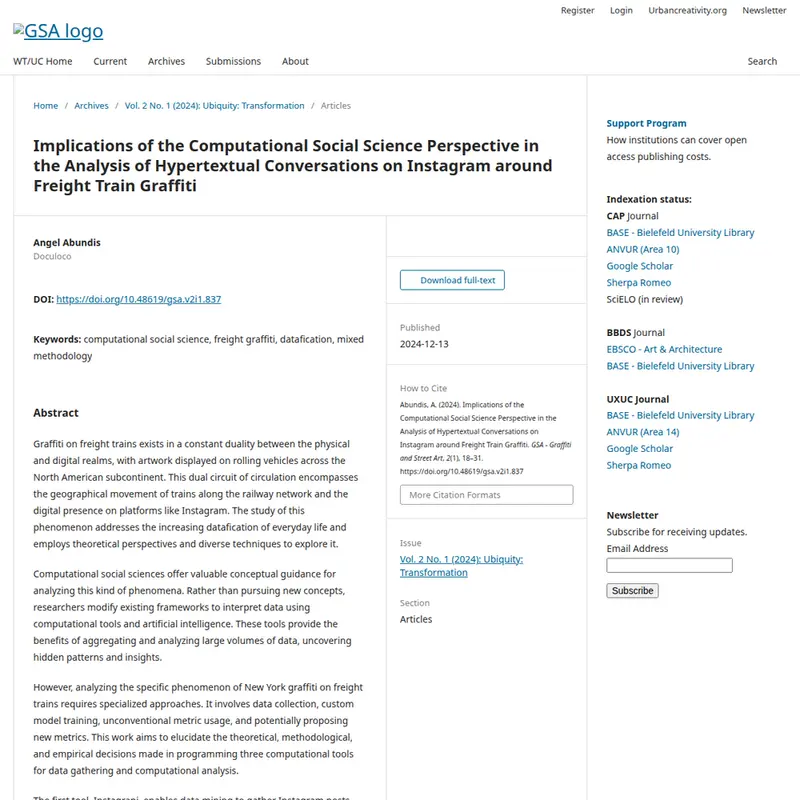
Academic article accepted in the Graffiti and Street Art Journal (Portugal). Presents a theoretical-methodological reflection on how the computational turn and computational social science redefined research on freight train graffiti in the North American region.
The text documents the combination of quantitative techniques (such as processing relational graphs of Instagram conversations and vectorizing discourse corpora) with traditional qualitative techniques (field ethnography in Guadalajara railway yards and interviews with writers). It discusses how computational methods reveal structural patterns that overcome the geographic limitations of traditional fieldwork while preserving qualitative sociological rigor.